
After an ADR, spec, epic, story or design is written or changed
Looks for weak spots, checks every claim against the source and asks how the plan could fail. No flattery.
opus · maxProjectStore is a method and a framework for building apps and services of any size with AI agents.
First of all, it is a way for a person and agents to work together. You decide what to build. An agent writes the plan, a second agent looks for holes in it, and you approve. Then the agent builds, and a third checks the result against your checklist, item by item.
It installs as a plugin in Claude Code and Codex. From then on you talk to the agent in your own words, and it keeps the decisions, plans and progress as plain files in your project. Tomorrow, on another machine or in another agent, the work picks up where it stopped.
Works in Claude Code and Codex. OpenCode soon; Gemini, Z.ai and DeepSeek next.
| Approach | What drives the work | When it is “done” | Strength | Weak spot |
|---|---|---|---|---|
| Prompt in a chatscope: one session | The conversation with the agent | The agent said “done” | Fast and simple: say it in your own words and the code appears | No plan and no check. Everything lives in one session and is forgotten by tomorrow |
| Agent memoryMem0, claude-mem, Claude Code auto memoryscope: an agent or a machine | Facts the model remembered from conversations on its own | Not defined: memory only reminds | Nothing to do: the agent remembers your habits and your environment by itself | It writes itself, without your approval; it lives with one agent or on one machine; what goes stale is quietly dropped, not replaced with a reason |
| SDDspec-driven developmentscope: a feature | A specification: first how it should work, then the code. GitHub Spec Kit, for example | The code matches the spec | Think first, then write: the “how” is written before the code | A spec covers one feature: the project's decisions and the links between features stay outside it |
| PDDproof-driven developmentscope: a change | Proof: every change comes with evidence that it works | There is a test, a command run or a line of code | “Done” is proven by a test or a command, not by the agent's word | It proves the code works, not that the right thing was built: without a spec and a plan there is nothing to check it against |
| ProjectStorescope: the whole project | The project's decisions, specs, stories and plans in git, linked to each other and to the code | The reviewer found evidence under every acceptance criterion | All four at once: your own words, memory of the project, a spec and a plan before the code, proof after — for the whole project, many sessions, people and agents | Running the loop costs tokens: the drafts, the critic and the reviewer run on the model you already pay for |
ProjectStore takes the best of all of them: your own words, memory between sessions, a spec before the code and proof after. And it keeps that for the whole project and the whole team, not for one feature or one machine.
| Approach | Many sessions | Several people | Backlog and plan | Decisions with reasons | Proof of “done” | Easy to start |
|---|---|---|---|---|---|---|
| Prompt in a chat | 0/3 | 0/3 | 0/3 | 0/3 | 0/3 | 3/3 |
| Agent memory | 2/3 | 0/3 | 0/3 | 1/3 | 0/3 | 3/3 |
| SDD | 1/3 | 2/3 | 1/3 | 1/3 | 2/3 | 2/3 |
| PDD | 1/3 | 1/3 | 0/3 | 0/3 | 3/3 | 2/3 |
| ProjectStore | 3/3 | 3/3 | 3/3 | 3/3 | 3/3 | 2/3 |
Three dots: it holds by itself; two: partly; one: with manual work; none: not at all. The rating is ours. ProjectStore gets two dots for “easy to start”: it needs Node.js and a plugin install.
One task for an evening?
yesPrompt in a chatquick and simple
nothe project grewIs it enough that the agent remembers only you?
yesAgent memoryremembers you on this machine
noOne feature with a clear “how”?
yesSDDa spec before the code
noIs it enough to prove the code works?
yesPDDa test instead of the agent’s word
noProjectStore — a project for months: many sessions, several people, a backlog. And everything above: your own words, memory of the project, a spec before the code and proof after.
Your agent runs the commands for you. You install two programs, open a project folder and paste one sentence.
An agent is a program that writes and runs code from your words. Either works: Claude (the app, its Code tab) or Codex by OpenAI.
Node.js is what ProjectStore runs on: the LTS installer from nodejs.org, version 20 or newer, on macOS or Linux. Make an empty folder, say “my-bot”, and open it in the agent.
Ask your agent or run the command in a terminal in the project folder.
Install the projectstore plugin from https://github.com/SmartAndPoint/ProjectStore and set it up for this project.
npx projectstore setup
After installing, restart the agent; Codex asks once to approve its hooks.
I want to create a stock trading bot
The agent asks what only you can decide, before it plans:
The project is empty—no code, and the vault just has README scaffolding with no epics, stories, or ADRs yet. Per CLAUDE.md, I'll start with an epic and its stories in the vault rather than code, but first I need you to make a few decisions that will shape the plan.
Should the bot trade real money?
From a real Claude Code session on an empty project, 21 October 2026. The agent's text is quoted word for word; the option details are shortened.
The critic has checked it by then. After your yes, the agent builds it, and the reviewer checks the result against the checklist.
Just talk to your agent, in your own words. For example:
I want to create a stock trading bot
It asks what only you can decide, then writes the plan: epics, stories, a checklist for each. No code yet.
Let's go with Postgres, not Mongo — we need transactions.
The decision becomes a file with the options you turned down. Later sessions follow it instead of deciding again.
Take the next story and build it
The planner finds where it goes, the agent writes code and tests, and the reviewer checks every point before it counts as done.
Where were we?
A new session reads the board and the story in progress, and carries on from there.
We build ProjectStore with ProjectStore.
Agents write code fast, and they re-decide settled questions just as fast: every fresh session arrives empty. The fix is not a smarter agent. It is gather context → act → verify, run over the project and not only over the code.
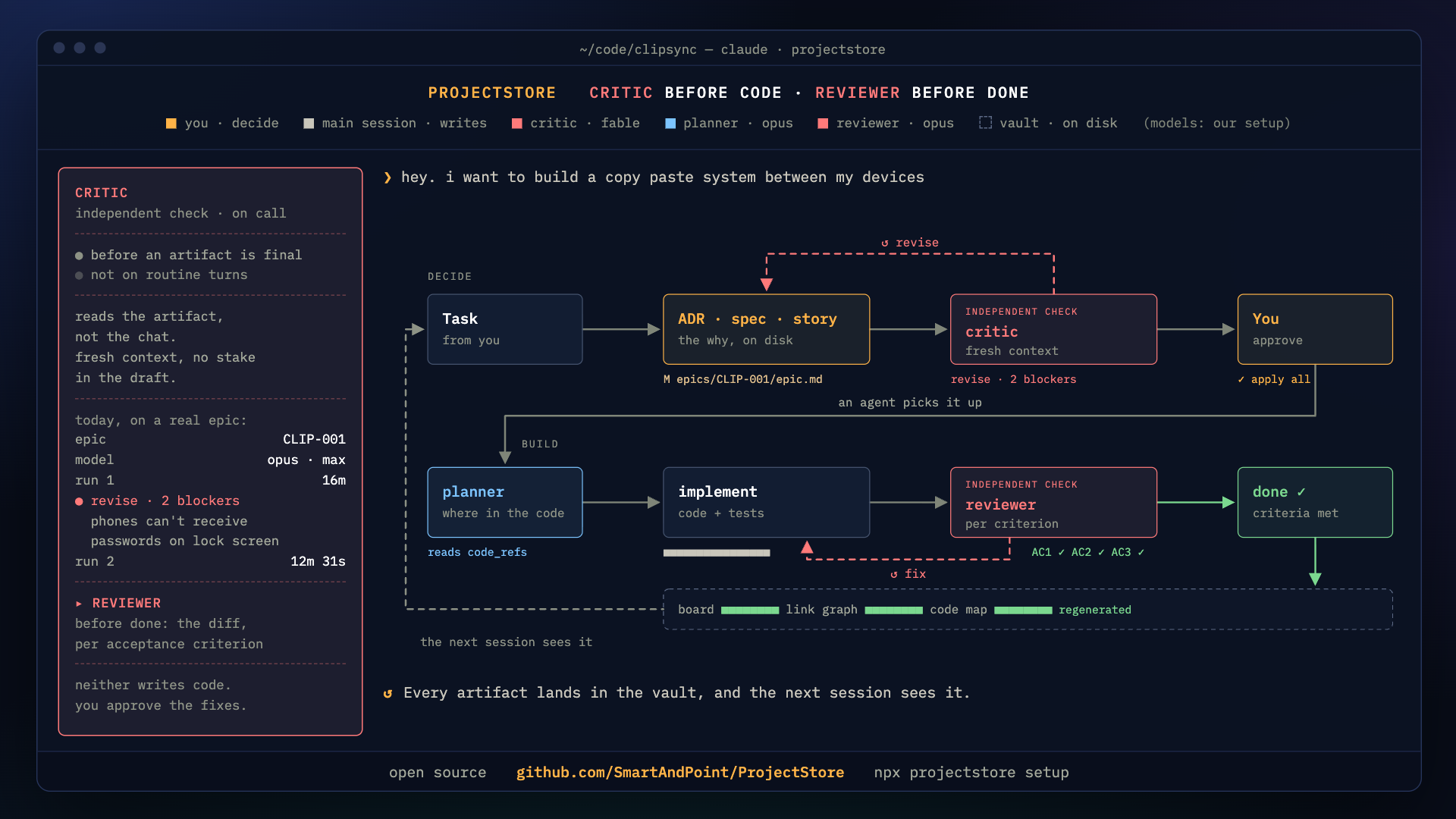
The advisors check, plan and tidy up, and change nothing. One clerk saves only what you approved, after your Yes.
After an ADR, spec, epic, story or design is written or changed
Looks for weak spots, checks every claim against the source and asks how the plan could fail. No flattery.
opus · maxBefore work on a story starts (story plan)
Looks at where earlier epics live in the code. Says where the change belongs, what to reuse, what to watch out for and in what order to work.
opus · maxAfter code, before commit or story close
Asks for proof on every acceptance criterion, including the spec's. Then checks correctness, regressions and tests.
opus · maxFrom time to time, before releases, after the vault grows fast
Finds what no rule can catch: research notes that contradict an accepted ADR, duplicates, missing links, files ready to archive.
opus · maxOnce, after binding an existing codebase
Finds decisions nobody wrote down, in the code, config files and git history. Suggests ADRs for them, with evidence.
opus · maxOnly inside a command flow, only after your Yes
Saves exactly what you approved, nothing more. Then rebuilds the board and runs the checks. Writes nothing of its own and asks nothing.
sonnet · maxThe default models are Claude Code's. In Codex each role is a skill of the same name that asks Codex to start the role, such as $projectstore-critic for the critic; it uses the session's model unless you set one.
An agent that starts editing code with no story open is reminded to open one. A feature-sized change starts in the vault.
An artifact that needs review carries review_status: pending until a critic pass is applied. "Not yet reviewed" is a state the tools can read, not something someone must remember.
doctor checks the vault's mechanical consistency deterministically. In CI it runs with no agent and no tokens.
graph.md holds every artifact's links in both directions; code-map.md says where each epic's code lives. Before an architectural choice, the agent is pointed at the ADR index first.
/compact, the vault comes backIn Claude Code, after a /compact you run, the session starts with the vault's orientation again, and with the vault files the conversation touched before it.
A session that starts while another one works on the same vault opens with a multi-session warning: search before creating anything new.
---
type: story
epic: "CHECKOUT"
title: "Saved cards are listed at checkout"
status: done
code_refs: ["src/billing/cards/", "tests/cards.test.ts"]
closed_at: "2026-07-14T16:02:11Z"
---

## Acceptance Criteria

- [x] Saved cards are listed first — evidence: tests/cards.test.ts:21
- [x] A declined card shows the bank's reason — evidence: tests/cards.test.ts:58
- [x] No card number reaches the logs — evidence: tests/cards.test.ts:73
The planner said where the change belongs before the code, and the plan went into the story on your yes; the reviewer checked the diff against each criterion after it. Each line of proof is a test, a command that ran, or a line of code.
Any agent can read this record, with or without the plugin: through the CLI, which answers with JSON and needs no tokens, or through the MCP server's 9 read-only tools.
The context belongs to the team, not to one developer's chat. ADRs and specs go through pull requests, like code. What gets reviewed is the reasoning.
Two agents or two people in one vault at the same time is normal. Each session knows about the others, and a few simple rules keep them out of each other's way.
developer A has worked on CHECKOUT since 13:35. you open a second session:

⚠ Multi-session warning — 1 other projectstore session active.
  Run /projectstore:search <topic> before creating new artifacts.

later, once your work settles on “Saved cards are listed at checkout”:
projectstore: this session looks like "checkout-saved-cards-are-listed-at-checkout"
  → /rename checkout-saved-cards-are-listed-at-checkout
The developer, the tech lead and QA work from the same decisions and criteria. A person without an agent needs only GitHub or a Markdown editor: it is just files.
The context is available to the whole team, not only to the owner of the chat.
In one project, the API, Web and Platform teams run their own epics on top of shared ADRs and specs. A change to a shared contract is discussed in review with the teams that use it. ProjectStore shows which stories depend on it.
Who owns which artifacts and who signs off on contracts is the team's call.
The planner reads the decisions and the code map. The implementer reads the story and the spec. The reviewer reads the diff and the criteria. Each gets the context it needs, not the whole history of someone else's session. Sessions on the same vault warn each other.
Launching agents and handing work between them is the job of your harness or orchestrator.
An example of organizing the work, not live orchestration
ADRs, reviews, a backlog, acceptance criteria, links from goal to code. Mature engineering teams have worked this way for twenty years. ProjectStore invents none of it.
people's process+agents' speed=ProjectStore
ProjectStore puts the two together. Agent speed makes the old process cheap for the first time. Its documents, kept in files beside the code, give agents what they never had: the project's context, linked up to the goals and down to the code. A second agent that did not write the draft reviews each step, by rule. Speed gets a memory, and memory gets a check.
The links live in the header of each file, and the proof is a line under each acceptance criterion. The agent fills all of it in as it works. The link map shows what each document connects to. The code map shows where each epic's code lives. A new session, a new model or a new colleague starts from this chain, not from nothing.
MIT license. The notes are yours: plain files in your own repository.